

AudioMap: who it is for and use cases
AudioMap transcribes Spanish audio and video with speaker identification and generates notes with AI templates, mind maps and a chat that cites the audio.

An analysis of Tiendifai: the problem it solves, what it does today as checked in its code, how it works, its real shops, its competitors and what it does not do yet.
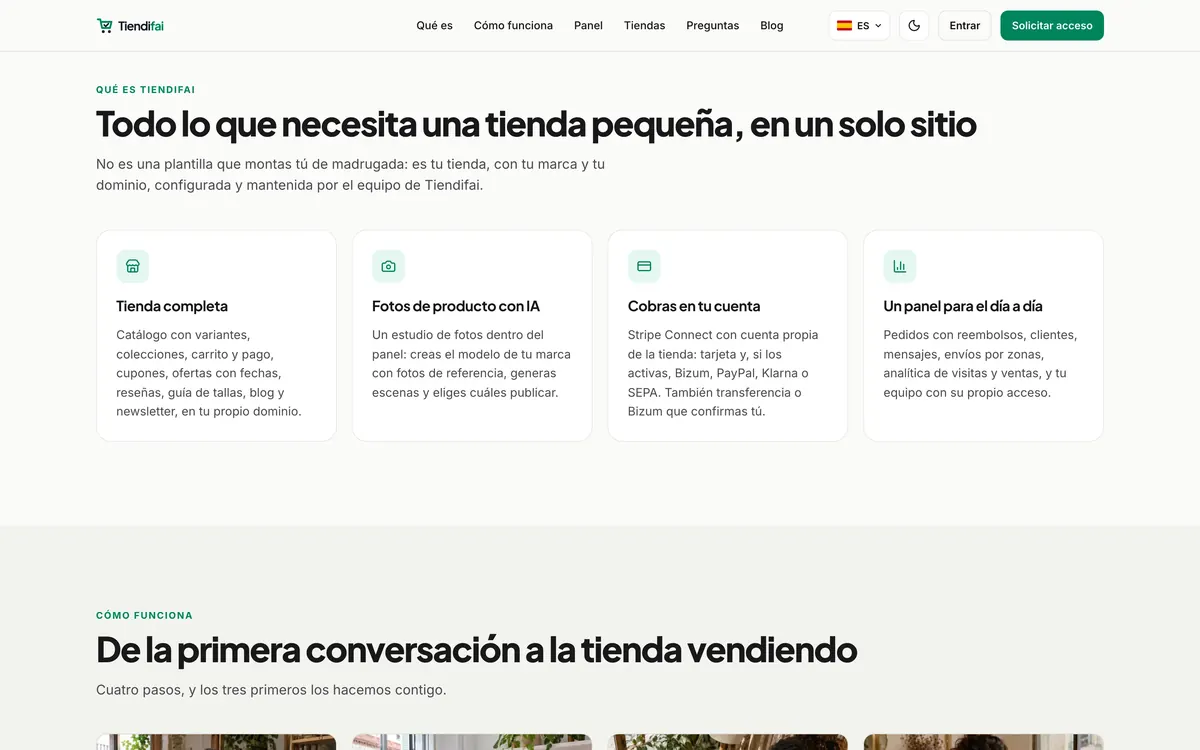
Tiendifai is an online shop platform where each shop has its own domain, its own design and its own database, with the catalogue, cart, payment, shipping and content in one dashboard, and with catalogue photos requested with AI from the product page itself. It belongs to Codelabs Studio, it is in a private beta and it already serves two real shops.
This analysis is based on its code as of 15 November 2026: what it does, how it is built, who it competes with and what it does not do yet.
Setting up a small online shop today means putting pieces together: a platform, a theme, several extensions, a payment gateway, sometimes separate hosting, someone to maintain it and, above all, photos. Each piece has its own bill and its own way of failing, and the owner of a small brand ends up spending more time on the shop than on her products.
Tiendifai puts those pieces into one managed platform. It is for small fashion, swimwear and jewellery brands that want their own shop on their own domain; for businesses that want to sell online without building or maintaining the shop; and for shops that need a catalogue photo for every product and have no studio.
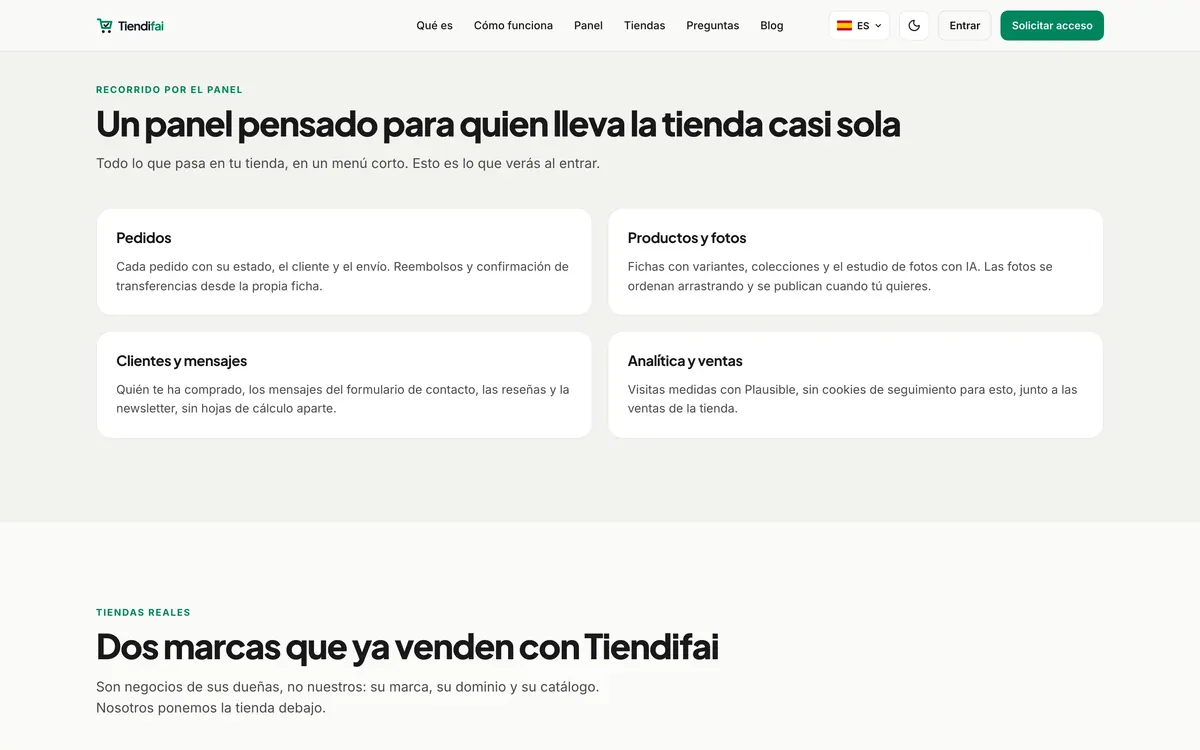
Each shop is served on its own domain and has a dashboard with orders, products, collections, customers, messages, analytics, offers, coupons, blog, newsletter, reviews, brand models, brand and storefront, translations, shipping, payments and team.
The catalogue supports variants, collections and categories. The cart validates prices on the server. Card payments go through Stripe Connect, with each shop's own account, and bank transfer or Bizum confirmed by the shop can be switched on too. Shipping is set by zones, with free shipping above an amount. Stock is reserved at payment and released if the payment does not arrive.
Orders are followed end to end: emails for confirmation, shipping, delivery, cancellation, return and refund, and a timeline for the buyer. There are percentage, fixed-amount and free-shipping coupons, automatic offers by catalogue or collection, moderated reviews and a newsletter.
To be found, each shop generates its sitemap, robots.txt, llms.txt, structured data and language tags, and connects to Search Console. It has its own blog with translations. Analytics use self-hosted Plausible, and the Meta pixel only after consent. There are three templates (classic, editorial and one designed for appliances) with each shop's colours, fonts and logo.
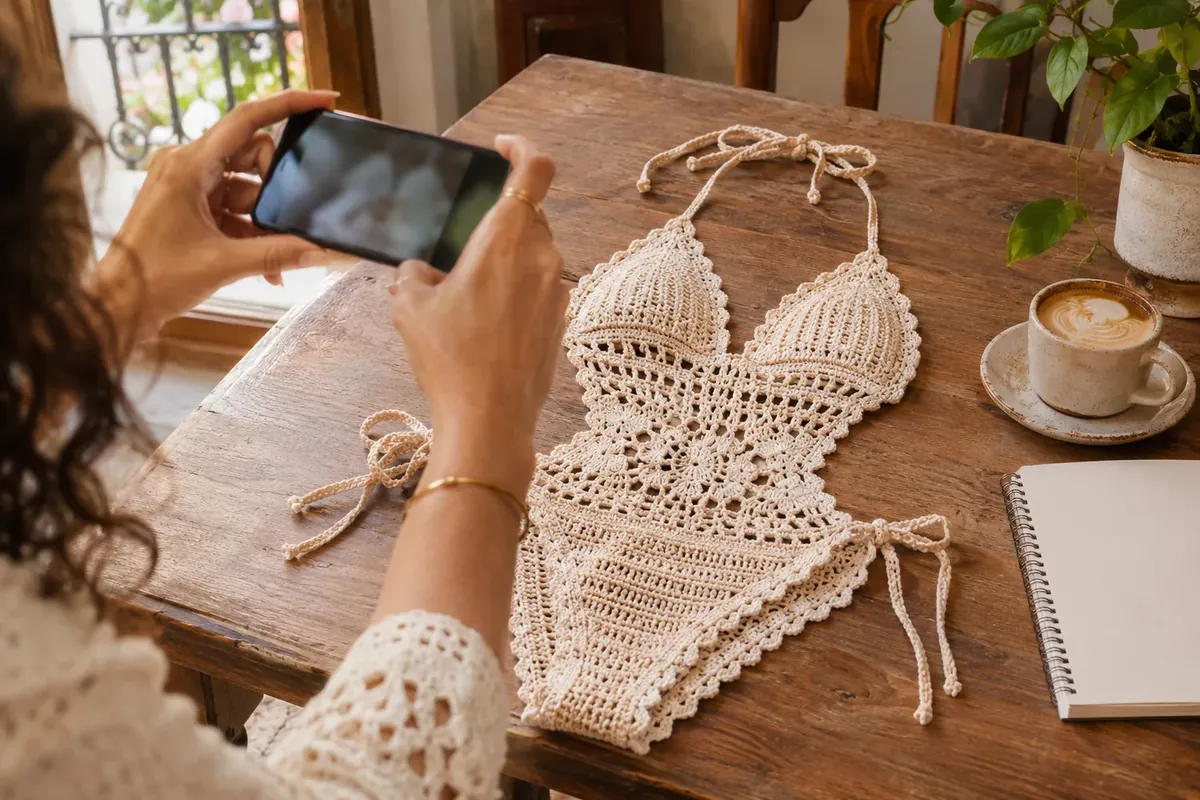
What sets Tiendifai apart is in the product editor: from the product page itself the owner requests AI photos with a clean background or worn by the brand's model, and they are saved in the shop. Each shop connects to the photo service with its own key and never falls back to a shared one: without its key it shows as «not connected» rather than touch another shop's data.
That service is a member of the family. The first photos were made with Fotifai and, since September 2026, AvatarSuite generates them through the same API contract. The owner sees «AI photos» and does not need to know which engine is behind it.
Tiendifai is a Next.js application with React, Prisma and PostgreSQL. Each request arrives with a domain and the platform works out which shop it belongs to. Each shop has its own database, so one shop's catalogue, orders and customers never mix with another's. Owners and their team sign in with Keycloak; buyers have their account inside each shop. Images live in Cloudflare R2 and emails go out through our own mail server.
The code includes AI tools for text (translation, article writing and a brand assistant), but they are switched off on the server as a product decision: content is prepared and reviewed before it is published.
Two real shops run by their owners are served on Tiendifai today, each on its own domain: Oreaster (oreaster.com), a swimwear brand, and Blossom by Olha (blossombyolha.com), a jewellery brand that sells in English. Both share the editorial template with their own branding, and their catalogues carry AI catalogue photos made from phone photos.
In August 2026 the full purchase cycle of both shops was walked through in production with payments in test mode: cart, payment, emails, shipping, delivery, return and refund. That walk-through is the basis of what works today.
E-commerce in Spain is large and still growing. According to ONTSI's «Compras online en España» study, 2025 edition, business-to-consumer e-commerce turned over 110,683 million euros in 2024 and 29.4 million people bought online (https://espanadigital.gob.es/en/actualidad/el-ontsi-publica-la-edicion-2025-del-estudio-sobre-compras-online-en-espana-que-confirma). The CNMC measured 25,752 million euros in the first quarter of 2025, 18.2 % more than a year earlier (https://www.cnmc.es/ca/node/416422?page=0).
Tiendifai's competitors are the platforms people use to build a shop today. The figures below come from their own websites, read on 15 November 2026.
Shopify is a hosted platform. In Spain its Basic plan costs 36 euros a month, or 27 a month paid yearly; Grow, 105 or 79; Advanced, 384 or 289; and Plus starts at 2,100 euros a month. With its own gateway, Shopify Payments, an online card sale costs 2.1 % plus 0.30 euros on Basic, and using another gateway adds a 2 % fee on that plan (https://www.shopify.com/es/precios).
WooCommerce is a free WordPress plugin, but hosting is paid separately, which its own page puts at 25 to 350 dollars a month, and so are extensions, at 29 to 299 dollars a year each (https://woocommerce.com/pricing/).
PrestaShop is open source, with a version you download for free and host yourself and another hosted by PrestaShop; its website mentions more than 250,000 merchants (https://prestashop.es/). We could not verify the prices of the hosted version.
Tiendanube is strong in Latin America, but its help centre says shops can be opened in Argentina, Brazil, Mexico, Colombia and Chile, and Spain is not listed (https://ayuda.tiendanube.com/es_ES/sobre-tiendanube/en-que-paises-puedo-usar-tiendanube).
Wix is a website builder with an online shop. On 15 November we could not read its prices on its official website, so we quote no figures for it.
Shopify wins on its app ecosystem, scale and integrated payments. WooCommerce wins on full control, free software and the WordPress community. PrestaShop wins on control, its module marketplace and its European community. Tiendanube wins in Latin America. Wix wins on how easy it is to build a whole website.
Tiendifai does not compete on extensions or size. It competes on something else: it delivers the shop managed, with its own domain, design and database, and with the catalogue photo solved inside the product page. For a small brand that means fewer pieces to put together and fewer bills to add up.
It is fair to say what it lacks against them: there is no app marketplace, there are only three templates, it does not calculate taxes or charge in several currencies, and sign-up is not open to everyone yet.

There is no plan catalogue in Tiendifai's code today: the plan screen in the dashboard says «Coming soon». The website does not publish a price: conditions are agreed with each shop, in writing, before starting, so we give no figure here. When it is, it will be on its website.
Real charging is closed by default: card payments are implemented, but the shops are still in test mode. Sign-up is not open: the website collects emails for early access and the team creates each shop and connects its domain. There is no tax engine and no multi-currency. Shops are served today in Spanish, English and Ukrainian, the three languages the website announces.
AI customer service on Instagram, WhatsApp or Messenger and building the shop by conversation, which the website used to announce, are not in the shops: the only AI chat is the sales one on tiendifai.com. The AI text tools are switched off. Owner sign-in with Google is switched off and buyer sign-in with Google is pending.
Tiendifai combines pieces that already work in other Codelabs products. AI photos come from the family's photo service: Fotifai at first and AvatarSuite now, through the same contract. The «Tiendi» sales chat on tiendifai.com is an AgenteUno agent. And the appliance template, with technical sheets, quotes and installation services, shows how one base adapts to another sector, just as the suites do.
Tiendifai is in production in the sense that two real shops are served on it, each on its own domain. It is in a private beta in everything else: invitation-only sign-up, payments in test mode, version 0.1.0. On codelabs.studio it is listed in the main grid of the Suite family.
Add up what your shop costs you today, or would cost to build: platform, theme, extensions, hosting, photographer and your own hours. If most of it goes on separate pieces and photos, Tiendifai is designed for you. If you depend on a specific extension, sell in many currencies or need to open tomorrow with real payments, one of the big platforms serves you better today.
Go to https://tiendifai.com, look at the shops already running and request early access.
You may also like


Your complete online shop, set up and run by us. Its product page lists the plans, who it is for and how to start.
See the product page of TiendifaiAudioMap transcribes Spanish audio and video with speaker identification and generates notes with AI templates, mind maps and a chat that cites the audio.

AvatarSuite creates a character from a few photos and generates images and vertical clips with their voice from a single sentence.

BeautySuite puts an assistant on your salon's website: chat at any hour and a call button, using your real treatment menu, with every call recorded in the dashboard.