

AudioMap: who it is for and use cases
AudioMap transcribes Spanish audio and video with speaker identification and generates notes with AI templates, mind maps and a chat that cites the audio.
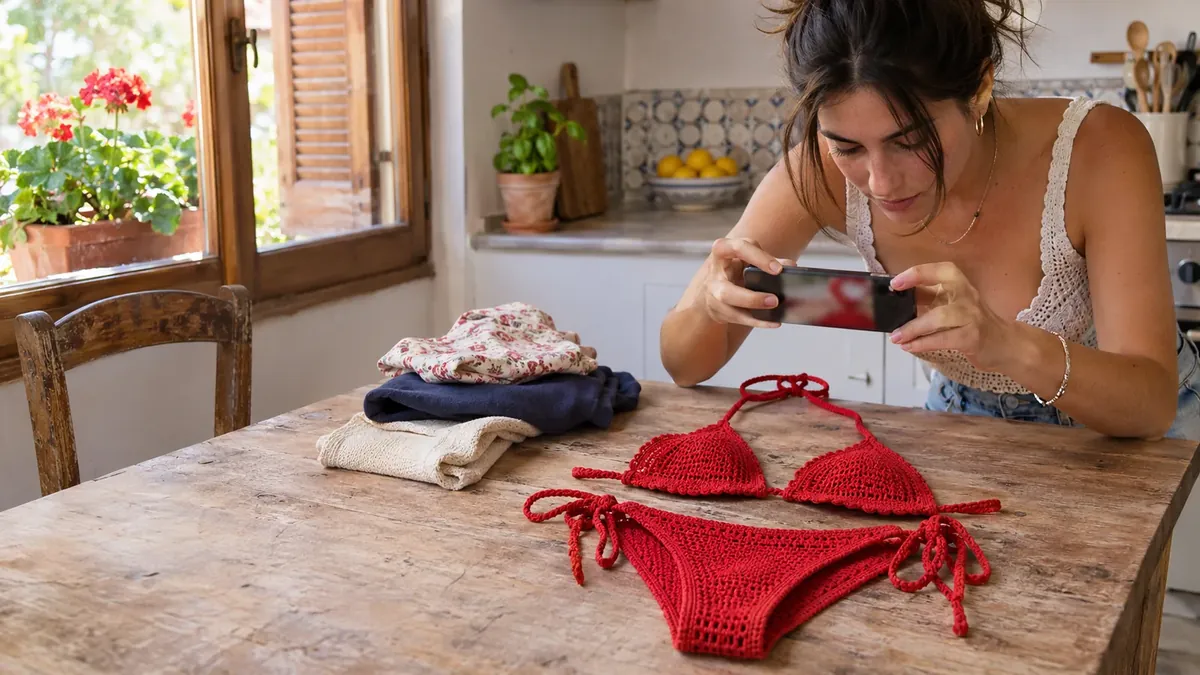
An analysis of Fotifai: the problem it solves, what it does today as checked in its code, how it works inside, its prices, its competitors and what it does not do yet.
Fotifai turns a product photo taken with a phone into a catalogue photo: the item alone on a seamless white background with a soft shadow, the item in a new scene, or the item worn by the brand's own model, always the same one. It is a Codelabs Studio product, it is in a private, invitation-only beta, and its first real photos belong to two shops that really exist.
This analysis covers what Fotifai does today, checked in its code on 15 November 2026, how it works inside, what it costs, who it competes with and, just as plainly, what it does not do yet.
An online shop sells with photos. Customers cannot touch the garment or try on the ring: they decide on what they see. Catalogue photos need a studio, lighting, a photographer and, in fashion, swimwear or jewellery, a model. For a small brand a shoot every season is hard to justify, and phone photos taken on the kitchen table do not inspire the same trust.
Fotifai is for three kinds of user: fashion, swimwear and jewellery shops that need consistent product pages without a studio; brands that want the same model to wear their whole catalogue, season after season; and agencies or developers that need to generate photos from their own systems, through the API or from WooCommerce.
It does not try to replace a creative campaign or a photographer's fine retouching. Its ground is the product-page photo: many of them, consistent and fast.

Fotifai has two modes. Product mode removes the clutter behind the item, corrects light and colour, and delivers it on seamless white with a soft shadow, on a new background or in a generated scene. It uses the customer's photos as the reference: it does not invent a similar item, it starts from theirs.
In avatar mode the brand creates its model from a few photos of a real person (up to five per job: front, side, three-quarter, back or face) and can describe the features that must never change. Each product comes out worn by that model, in a catalogue pose or in a scene. Models are saved and reused across the catalogue.
Around those two modes there is a REST API with keys (up to five per account) and a typed TypeScript client; asynchronous jobs that are launched and polled; regenerating an image or retouching just one area with a mask, today from the API (it is being prepared for the dashboard); and a WooCommerce plugin, in beta, that adds an «IA Fotos» tab to the product page and sets the result as the featured image.
Resolution is set by the type of job, not by the plan: 2K for product photos and 4K in a 3:4 ratio for photos on a model. Uploads are PNG or JPG files of up to 10 MB.
Fotifai is a monorepo with an API (Fastify), a web app (React) and shared packages: the price and job catalogue, an API client and a library to embed the studio in a shop. Data lives in PostgreSQL and images in Cloudflare R2.
When a job arrives, the API checks the credit balance and queues it. A worker reads the product photos and, when needed, the model's; it builds the instruction for the engine for that type of job and sends it to the image generator. The main engine is Google's Nano Banana Pro; if it fails or refuses the image, Fotifai falls back to OpenAI and then to Replicate. The image goes through a technical check of format, size and dimensions, is saved in the product's library, and only then are the credits charged.
Two practical consequences follow. A failed job is not charged, because charging comes last. And the check is technical, not visual: a generative engine can change a detail, so every image should be reviewed before publishing, as Fotifai's own website says.
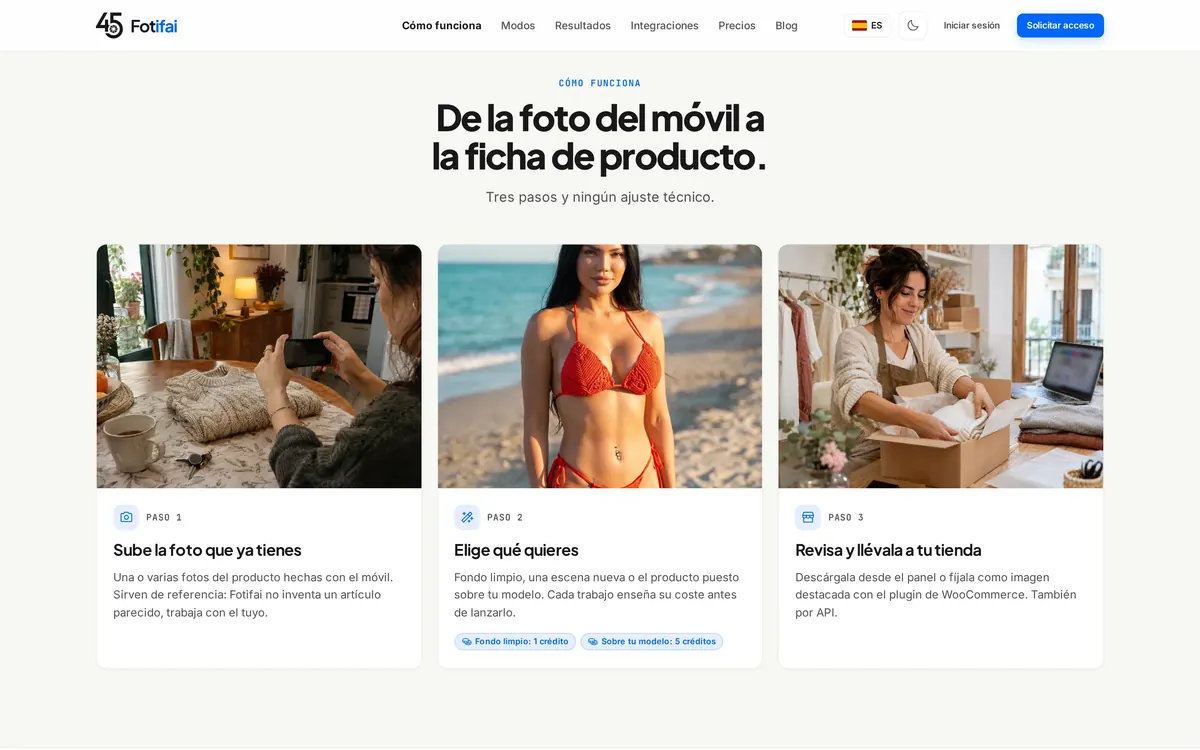
Fotifai was not born as a demo. Its first real photos belong to two shops run by their owners: Oreaster, a swimwear brand, and Blossom by Olha, a jewellery brand. Both sell on their own domains on Tiendifai, the shop platform of the same family.
At Oreaster the workflow was validated by hand with its catalogue: a phone photo of a crochet bikini lying on a table comes out worn by its model on a beach. At Blossom the model wears the brand's jewellery. Fotifai's website shows these examples by name.
These two cases show the product's strength: a small brand gets its own recognisable face across the catalogue without a shoot every season. Since September 2026 the new photos those shops request from their dashboard are generated by AvatarSuite, another member of the family that speaks the same API contract; the photos of their starting catalogue came from Fotifai.
AI product photography has serious competitors. These figures come from their own websites, read on 15 November 2026.
Photoroom sells its API per image: 0.02 dollars to remove a background and 0.10 dollars for AI editing, which includes generated backgrounds, ghost mannequin and virtual try-on, with 1,000 watermarked sandbox calls a month (https://www.photoroom.com/api/pricing). It has apps for iPhone, iPad and Android and lists integrations with Shopify, WordPress, Zapier and Make (https://www.photoroom.com/integrations).
Pebblely charges in dollars per images a month: Lite, 9 dollars for 30 images; Basic, 19 for 200; Pro, 39 for 500 (https://www.pebblely.com/pricing). Its offer is product scenes built from templates.
Flair has a free plan with 5 images, Pro+ at 26 dollars a month for 80 images and Scale at 38 dollars for 150, with its API in early access (https://flair.ai/pricing). Its strength is generated models and scenes made for advertising (https://flair.ai).
Claid (https://claid.ai) is another relevant competitor in e-commerce product photos, but on 15 November we could not read its pricing pages in full, so we quote no figures for it.

Photoroom wins on scale, on API price per image and on having a mobile app. Pebblely wins on entry price and simplicity. Flair wins on advertising quality and campaign scenes. All three publish their prices in dollars.
Fotifai plays somewhere else. It is built in Spanish and English for shops here, it is paid in euros, it shows the cost of every job before launching it, it does not charge failed jobs, and its strength is the same model, created from a real person of the brand, across the whole catalogue. Its first shops live on Tiendifai, which adds something the others lack: a shared API contract with the platform where the products are sold.
To be fair: Fotifai is in beta, has a single shop integration (WooCommerce, also in beta) and no mobile app. Anyone who needs tens of thousands of images a month through an API has more mature options today.
Prices come from the catalogue in Fotifai's code, the same one its website shows and its checkout charges. There are four monthly plans: Free, 0 euros with 10 credits a month; Básico, 19 euros with 100; Pro, 49 euros with 500; and Business, 99 euros with 1,000. There is no annual plan. When the balance runs out there are one-off packs: 50 credits for 4.99 euros, 200 for 14.99, 500 for 29.99 and 1,500 for 69.99. Companies and agencies with volume get a custom plan.
Each job costs credits: removing the background, 1; changing the background, enhancing the product or retouching an area, 2; a scene, 3; the product on the model, 5. Every plan includes every job, the models, the API and the WooCommerce plugin: only the balance changes. With Básico, for instance, you get 100 clean backgrounds or 20 photos on a model a month.
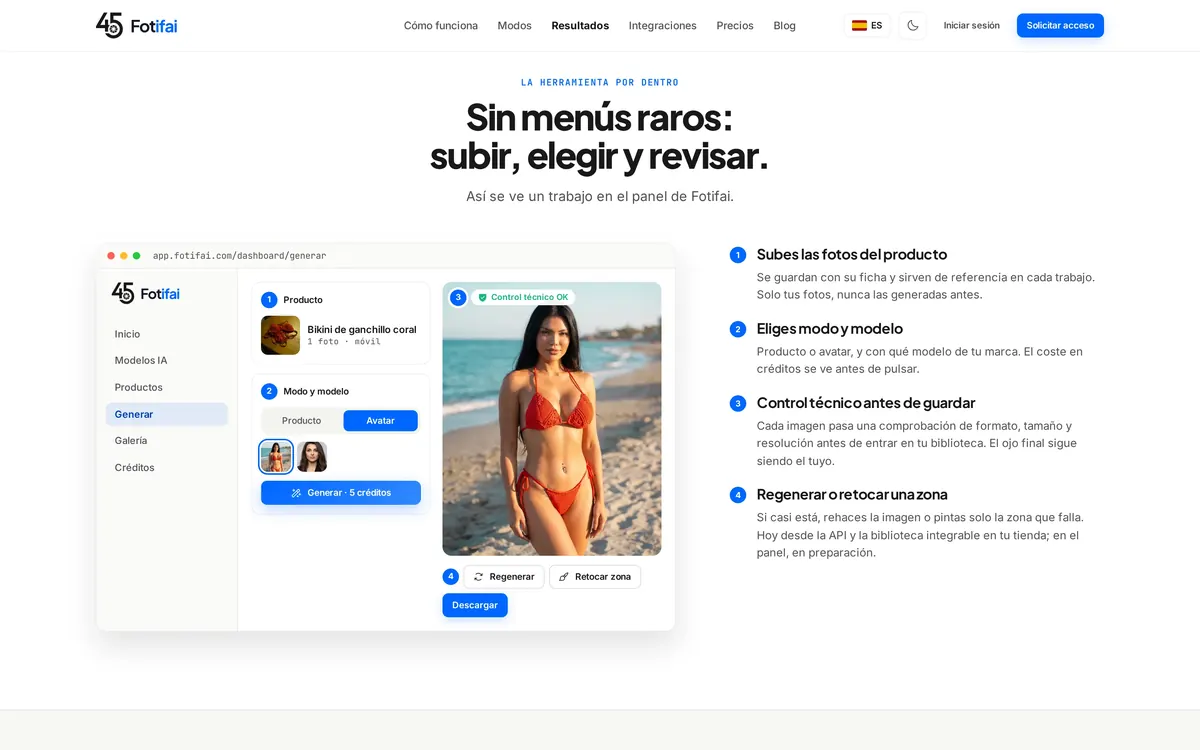
There is no PrestaShop module, Shopify app or MCP server: they are being prepared and Fotifai's website says so. There is no batch processing or batch download for customers: each photo is a job. Resolution is not chosen by plan and there is no watermark. It does not detect visual defects, because its check is technical. Area retouching and regeneration are in the API but not yet in the dashboard. And it does not make product videos.
Nor does it promise pixel fidelity without review. If a piece has an engraving, a clasp or a print that must not change, check every image before publishing it.
Fotifai is the image piece of a family of products that use each other. Tiendifai, the shop platform, talks to the photo service through a versioned API contract with one key per shop, and Fotifai has a sign-up endpoint that creates each shop's account with its own key. That same contract is served today by AvatarSuite, which also creates AI presenters for video: the idea of a brand's own face is common to both.
VideoSuite and AgenteUno cover video and customer service. The family's rule is to combine pieces that already work before building anything new.
Fotifai is in production at fotifai.com, with Stripe payments, R2 storage and real photos of two shops. At the same time it is in a private beta: access is by invitation with a waiting list, the version is 0.1.0, the WooCommerce plugin is not published in the WordPress directory and its blog is already published at fotifai.com/blog. On codelabs.studio it is listed in the main grid of the Suite family.
Start with the free plan and ten photos of your hardest products. Note how many are usable as they are, how many need regenerating and how long it took. If most are usable and the time is a fraction of what it used to be, move up a plan. If the details your customers look at fail, such as an engraving or a fabric print, that is just as useful a signal: it is not your tool yet.
Go to https://fotifai.com, look at the real examples and join the beta waiting list. If your shop runs on WooCommerce or you want to integrate it into your own system, ask for API access.
You may also like


Your phone photo, turned into a catalogue photo. Its product page lists the plans, who it is for and how to start.
See the product page of FotifaiAudioMap transcribes Spanish audio and video with speaker identification and generates notes with AI templates, mind maps and a chat that cites the audio.

BeautySuite puts an assistant on your salon's website: chat at any hour and a call button, using your real treatment menu, with every call recorded in the dashboard.

ClinicSuite brings together scheduling, a patient portal, digital consent forms, medical images and warranties in one management system for clinics.