

Lexiel: who it is for and use cases
Lexiel answers from a curated, multi-country body of law, citing the source, and gives firms case files, document drafting, case law, deadlines and billing.

MemoryFirst stores decisions, facts and context in a temporal graph with citations, resolves contradictions, and offers it to your company's AIs through MCP.
Anyone who works with AI every day repeats the context in every tool and every conversation: what was decided, why, with whom. Each assistant starts from zero, and the important decisions end up scattered across e-mails, documents and chats. With several agents, the problem multiplies: each remembers something different, or nothing.
MemoryFirst stores decisions, facts and context in a temporal graph with citations, resolves contradictions, and offers it to your company's AIs through MCP. It connects Gmail, Drive, Notion, Slack, WhatsApp and Telegram and sends a morning brief. It is for people who build with AI every day, teams that share a memory, and companies with several agents that must remember the same things.
Memory for the agent. An AI agent uses recall, record and query over MCP to look up what was decided before, with hooks for Claude Code, and records what is new.
Connect sources. E-mail, documents and messaging are integrated into a searchable memory, so a question such as what we agreed with a supplier gets an answer with its citation.
Morning brief. Every morning a summary of what matters arrives on Telegram.
Team memory. The shared memory, with a librarian queue, stops each person having their own version of the facts.

Decide what you want it to remember: product decisions, agreements with customers or working preferences. Connect the most valuable sources first (e-mail, documents, messaging) and define who can read what. If you work with AI assistants, check that they can connect over MCP.
MemoryFirst can be out of date if it is not fed: the quality of the memory depends on what is recorded. It is not a document archive, but a memory of decisions and facts with citations. The price of additional seats on the Team plan has not been settled, and the free plan keeps 30 days of retention.
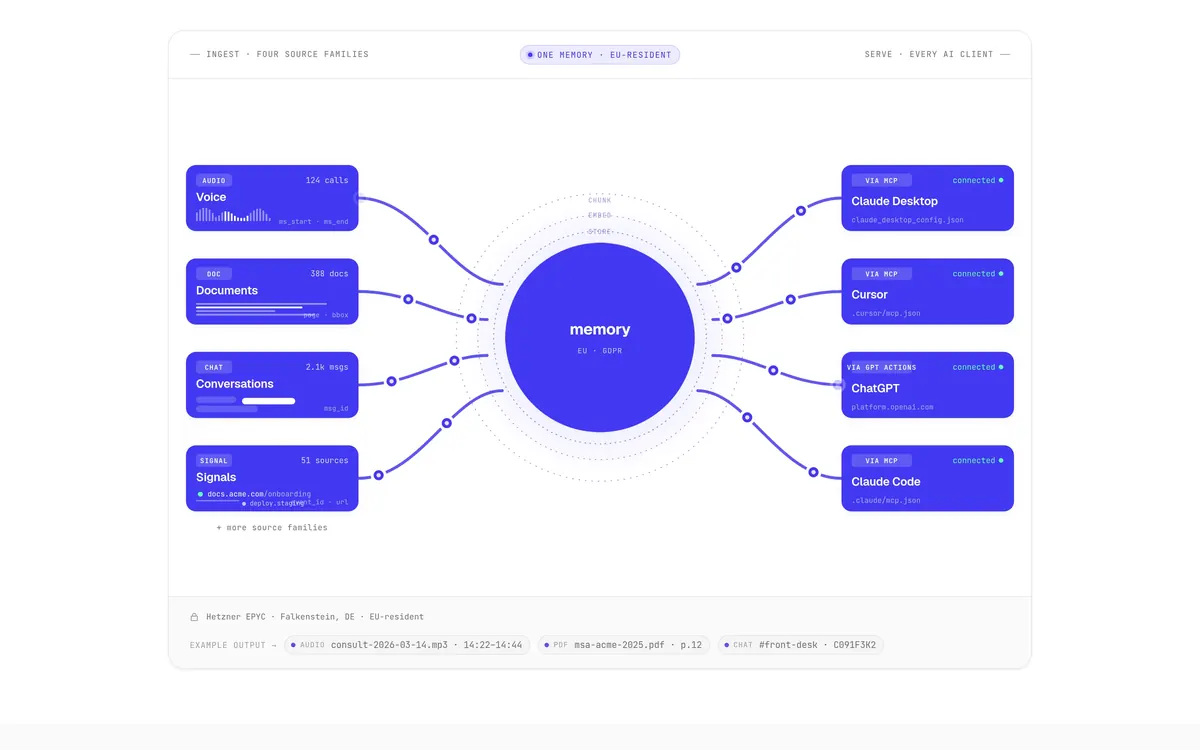
A small team starts its day with the morning brief on Telegram. A new person asks the memory why an option was dropped and gets the decision with its citation. Mid-afternoon, an AI assistant queries the context over MCP before drafting a proposal and records the decision that is made.
A good way to judge MemoryFirst is not to measure everything, but to look at what changes. Before you start, write down how "memory for the agent" is handled today: who does it, how long it takes and what is lost when it is not done. After a few weeks, look at the same thing again with MemoryFirst running. If the difference is obvious without doing any sums, it is worth continuing and trying "connect sources". If it is not, that signal is useful too: it means the product or the plan does not fit your case yet.
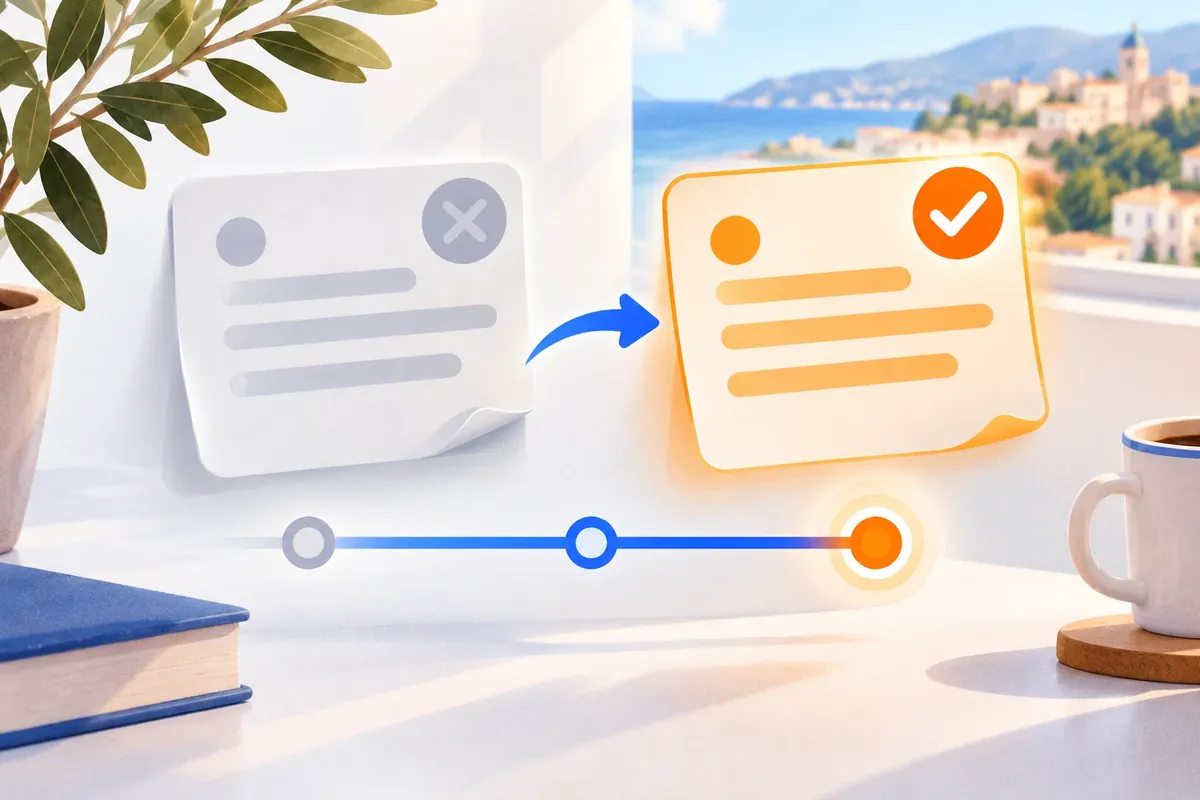
The company stops repeating the context to every tool and agent: decisions and data are in one place with their citation. That reduces errors caused by outdated information.
Teams start new tasks with the right history, and newcomers take less time to get up to speed.
When several AI assistants work for the same person or team, each one knows only its own fragment. A common memory stops them contradicting each other and saves repeating the work of explaining the context. And because it stores decisions with their citation and resolves contradictions, it lets you check why something was done, which is what most informal records lack. That traceability is what justifies spending a few minutes on the initial set-up.
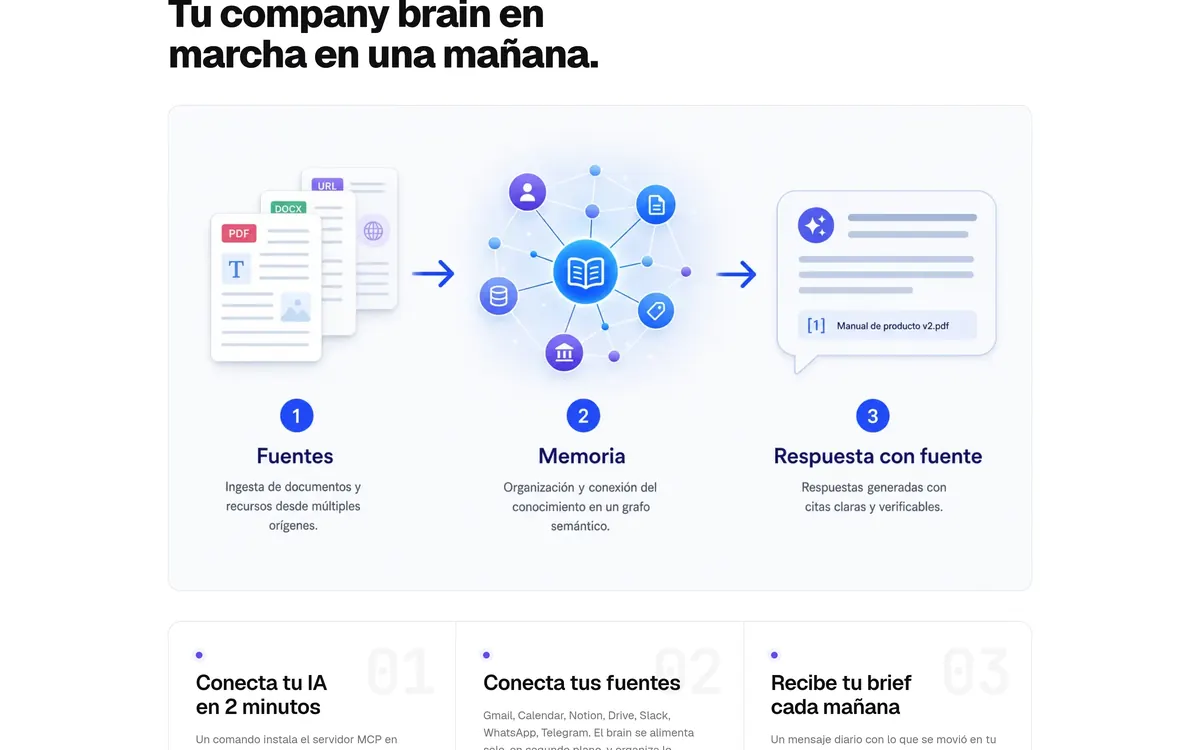
MemoryFirst is the memory that other products can build on. AgenteUno can remember with it, Memchats connects it in the Pro plan, TubExperto contributes external video knowledge and AudioMap contributes what was said in meetings. It is the piece that joins what was decided with what was heard.
The simplest way is to see it with your own data: go to https://memoryfirst.ai, watch the demo and test it against your case. If you would rather talk to a person, you can ask, but it is not needed to get started.
You may also like




The shared memory of your company and your AI agents. Its product page lists the plans, who it is for and how to start.
See the product page of MemoryFirstLexiel answers from a curated, multi-country body of law, citing the source, and gives firms case files, document drafting, case law, deadlines and billing.

Memchats imports WhatsApp, Telegram and Instagram conversations, and its adviser Alma understands the history to suggest how to carry on.

TubExperto indexes the videos of a channel and lets you ask the expert, with the answer cited to the exact second.