

Build for yourself first: why dogfooding teaches you what the customer needs
A lab that uses what it builds every day finds the faults, gaps and real priorities sooner. This is how we see it at Codelabs Studio.

Before buying tools, work out which repeated task costs you most when it is not done. A practical way to start with what you will notice.
When people talk about artificial intelligence in a small business, the conversation usually starts with the technology: which model, which platform, what is new. That is the wrong order. The useful question is a different one: what is not being done today, or is done late, or is done badly for lack of hands? That is the first candidate for automation, because value is measured by what you stop losing, not by what impresses in a presentation.
A simple criterion: look for tasks that repeat, that follow a recognisable pattern and whose failure shows up in the till or in your reputation. The phone nobody answers, the quote nobody follows up, the meeting minutes that never get written, the regulation question that takes an hour to look up. They are boring tasks, and that is exactly why they are good candidates.

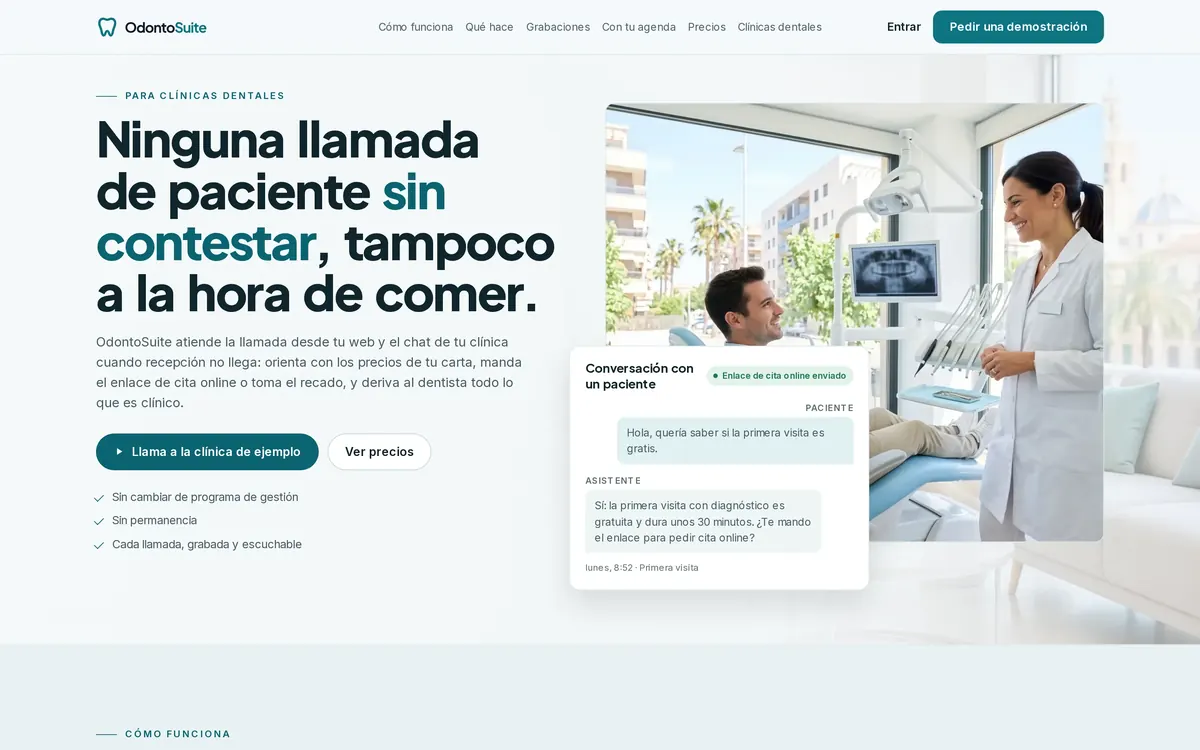
In many service businesses, the phone rings while the person who should answer it has their hands full: a hairdresser halfway through a colour, a dentist with a patient in the chair, an estate agent on a viewing. That missed call is a conversation that does not happen. AgenteUno is designed for that gap: it handles a business's calls and messages by voice, WhatsApp, web chat, SMS, email, Instagram and Messenger, answers with the company's information, books appointments and hands over to a person when needed.
If your sector is specific, there are versions that already come with the rules of the trade. BeautySuite uses the real treatment menu with prices and durations, and in aesthetic medicine it does not diagnose or recommend treatments, but refers to the professional. OdontoSuite follows the same health rules and follows up unanswered quotes with the patient's permission. StaySuite looks after the guest in their own language and warns if the nights requested are already taken. The general lesson is that useful automation knows the limits of the trade, and does not just reply.
The second big candidate is the knowledge that is generated by talking. Meetings with clients, calls with suppliers and recorded classes contain decisions and commitments that are forgotten within days. Transcribing and structuring that information is an ideal task for a machine: it is repetitive, it has a clear format and its errors can be spotted. AudioMap generates minutes with AI templates and lets you ask questions of the audio, with the citation of the exact moment. VideoSuite records the meeting room itself, with notice to participants, transcribes it and generates a report, with no bot and nothing to install.
For documents, the pattern is similar. Docu.expert answers in natural language about a company's documents or about public regulations such as the BOE or income tax (IRPF), citing the source, and there is a local version that is installed on the customer's computer or server so that documents never leave the network. If your information is sensitive, that difference matters more than any extra feature.

Some tasks are best left in people's hands for a while. Decisions with legal or health consequences, difficult conversations with an unhappy customer, and anything you cannot review before it goes out. The rule we apply ourselves is that the AI proposes and the person approves when there is risk. LaunchSuite takes that approach to product launches: an AI proposes the analysis, plan and calendar, and the person approves them, with a spending cap set.
Do not automate what you do not yet understand either. If you do not know how a task is done by hand, a system will only reproduce your confusion faster. Do it yourself for a few weeks, note the odd cases and then decide which part to delegate.
Imagine a clinic with three candidate tasks: answering calls, sending check-up reminders and producing social media content. For each one, ask what happens if it is not done. If calls are not answered, new patients are lost today. If reminders are not sent, check-ups are lost within weeks. If content is not published, visibility drops little by little. The order of automation falls out by itself: first what costs money immediately.
Apply the same reasoning to your own case with a short list. Write down each task, how often it repeats, how long it takes and what happens if it is not done. You do not need to measure it precisely: an honest estimate is enough to see which one stands out. And if you are torn between two, pick the one you can try this very week with a trial or free plan.
Whichever provider you choose, ask for four things. That it cites its sources when it answers with information, so you can check it. That it logs what it does, so you can review it. That it lets you hand over to a person when it does not know. And that it has a clear way out: if one day you stop using it, your data must be able to leave with you. Tools that meet those four conditions age better, and the ones that do not cost you more than it seems when the time comes to switch.
If we had to put them in order, it would be this. First, deal with what comes in: calls, messages, requests. Second, capture what is said: meetings, audio, documents. Third, recover what was left pending: unanswered quotes, inactive patients or customers, check-ups. Fourth, and only after that, produce content or analyse data. Each step builds on the previous one, and all of them can be tried with a trial version before committing budget.
And a practical warning: choose tools with clear pricing and no lock-in, so you can leave if they do not fit. With most of our products you can start with a trial period or a free plan and decide with your own data. That is, at heart, the whole strategy: one automation at a time, with your data, and with a clean way out.
You may also like


What we learn in each product goes into building yours too. Tell us what you need and we will reply with a proposal.
Tell us about your caseA lab that uses what it builds every day finds the faults, gaps and real priorities sooner. This is how we see it at Codelabs Studio.

When a customer can leave at any time, the product has to earn the renewal every month. Why that is a good discipline and how it translates into plans.

Maintaining a broad portfolio is only possible if every new tool serves all the others. How reuse works in practice.