

Selling without pressure: an open demo, an agent that explains and no closing calls
A way of selling based on letting the customer see the product, ask whatever they want and decide at their own pace. What it involves and what its limits are.

A lab that uses what it builds every day finds the faults, gaps and real priorities sooner. This is how we see it at Codelabs Studio.
There is a very common way of working in custom software: you listen to the client, build what was asked for, deliver it and move on to the next job. It is an honest model and sometimes a necessary one, but it has a cost that is almost never mentioned: what the team learns while building stays in a folder. Nobody uses the delivered product again under the pressure of a Monday morning, so the faults that only appear with daily use take months to come to light, and by the time they do there is nobody looking.
At Codelabs Studio, a lab in Málaga, we start from a different premise: before we offer something to a company, we have to need it ourselves. That is why our portfolio did not come from a catalogue of ideas but from our own problems: meetings that got forgotten, conversations we did not know where to keep, expert videos we had no time to watch, calls that went unanswered. Each product began as a tool to solve something of ours.

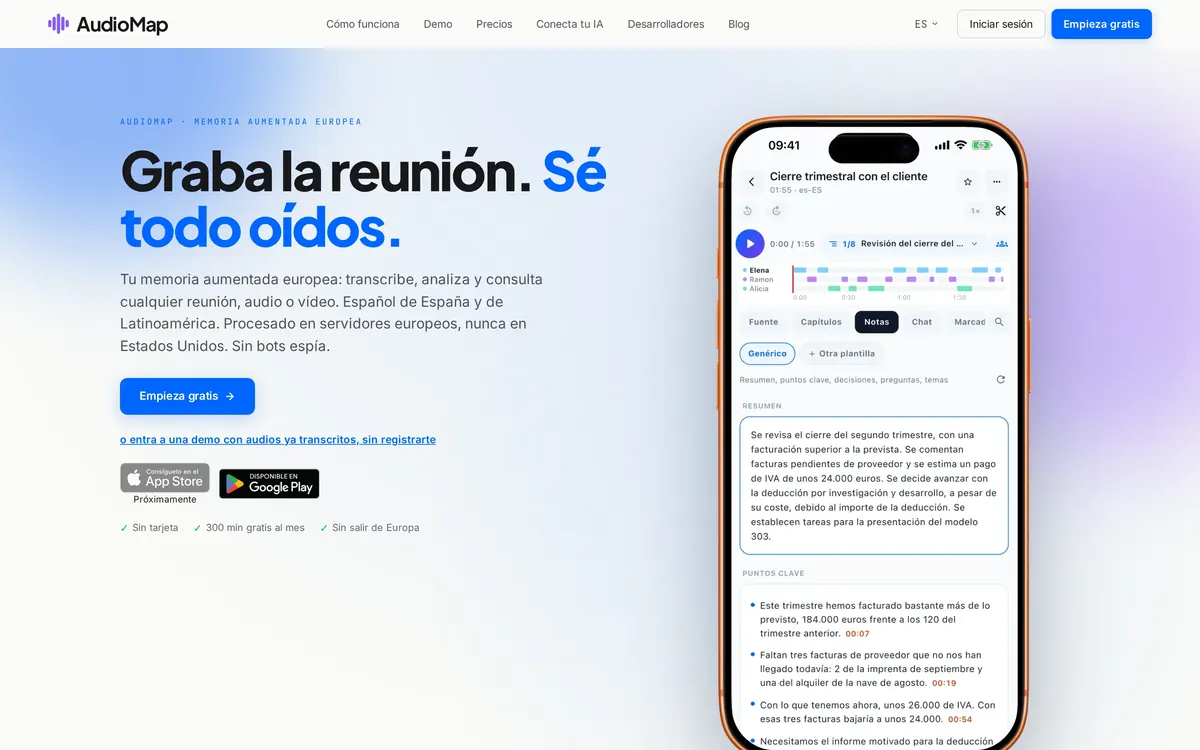
The first difference is how quickly a fault hurts. If the meeting transcriber gets a name wrong, you notice it the next time you want to look something up, not in a quarterly report. AudioMap, for example, transcribes audio and video in Spanish with speaker identification and produces notes, mind maps and a chat with citations from the audio. A tool like that only gets properly refined when the people building it depend on it to remember what was agreed.
The second difference is that the fiction of the nice-looking feature disappears. When you pay with your own time, you realise which button you never press and which screen you are missing. MemoryFirst, the shared memory for companies and AI agents that stores decisions and context with citations and is offered over MCP to other tools, exists because repeating the context to every assistant was an obvious waste of time for anyone who works with AI every day. We did not need a survey to know the problem was real.
The third is honesty about the state of things. When you use your own product you know whether it is finished. That is why our range includes products that are live, products in beta, such as Lexiel or Fotifai, and products in testing with early access, such as DivanSuite. Saying so plainly is not a weakness: it is the result of judging what you do by the standard of the person who has to use it.
Building for yourself carries an obvious risk: mistaking your case for everyone's. The way to avoid it is not to stop building for yourself, but to check early that others share the problem. A coach who wants to charge for a community, a clinic that loses calls at lunchtime or an estate agency that cannot get to the phone do not need us to explain our story. They need the tool to solve their specific situation.
This is where our own work turns into a practical advantage. AgenteUno handles calls and messages by voice, WhatsApp, web chat, SMS, email, Instagram and Messenger from a single conversation with memory. That engine, already proven in one context, is the base on which the sector versions are built: InmoSuite for estate agencies, StaySuite for rural accommodation, BeautySuite for beauty and aesthetics, OdontoSuite for dental clinics. Each adds what is specific to the trade (the property portfolio, the booking calendar, the treatment menu, the health rules) on top of a core that already existed.
This explains why, when a company asks us for something custom, we do not start from zero. We start from what we already use, adapt it to their data and their way of working, and only then does it make sense to talk about timescales and scope with a real base.

It is also worth saying what this approach does not solve. Using your own products does not replace listening to customers: it gives you a first compass, not a complete map. Some trades have rules you cannot discover from the outside. An aesthetic medicine clinic cannot be given an assistant that recommends treatments, and a law firm needs every answer to cite the legal source. You learn those constraints by talking to the people who live with them.
That is why the portfolio has a stable channel for that listening. FeedbackSuite adds to a product a side tab for leaving a written comment or a voice note of up to three minutes, and a questionnaire engine by invitation with a personal link. It is our way of asking the people who use what we make, at the moment they use it, and of getting spoken answers already transcribed.
Some knowledge does not come out of any interview. Memchats imports conversations from WhatsApp, Telegram and Instagram, and its adviser understands the history to suggest how to continue a delicate conversation, with a profile, a dated history and the commitments made to each contact. A tool like that is badly designed from the outside: you have to have reread a long thread many times to know that what is really hard is remembering what was promised and when, not drafting the reply.
The same goes for TubExperto, which turns a YouTube channel into an expert you can ask, with the answer cited to the exact second. Anyone who has tried to find one particular minute in a two-hour video quickly understands why the citation to the second matters more than the summary. Those priorities are not deduced from a market analysis; you notice them when you use the product in a hurry.
Dogfooding is not a marketing phrase, it is an uncomfortable discipline. It forces you to use a version that still fails, to put up with a clumsy flow until you fix it and not to hide problems behind a presentation. It also forces you to decide which products deserve to continue. If nobody in the studio uses a tool after a few weeks, that is a serious sign that it solves nothing, and the honest answer is to rethink it or shelve it.
You do not need to be a software studio to benefit from this idea. If you are thinking of building or commissioning a tool, ask yourself three questions. First: would you, or someone on your team, use it this very week? If the answer is no, you are probably building for a meeting and not for a use. Second: what data of your own feeds it? A tool without your data is a generic demo. Third: who will find out when it fails? If nobody, it fails for months.
Start with a small case that hurts every day, try it with your real information and let the people who use it say what is surplus and what is missing. What you learn that way is worth more than any specification written in advance, and it is the reason we prefer a product to exist for us first before we propose it to another company.
You may also like


What we learn in each product goes into building yours too. Tell us what you need and we will reply with a proposal.
Tell us about your caseA way of selling based on letting the customer see the product, ask whatever they want and decide at their own pace. What it involves and what its limits are.

When a customer can leave at any time, the product has to earn the renewal every month. Why that is a good discipline and how it translates into plans.

Before buying tools, work out which repeated task costs you most when it is not done. A practical way to start with what you will notice.