

Starting out with AI, no hype: what a small business should automate first
Before buying tools, work out which repeated task costs you most when it is not done. A practical way to start with what you will notice.

A demo with catalogue examples is not very convincing. A demo with your real information shows whether it is worth it. A method to validate before you pay.
Every demo works. They are prepared with clean examples, predictable questions and data that never contradicts the system. The hard part starts when the tool meets the reality of a specific business: a price that changes with the season, an exception only someone with ten years in the business knows, a badly scanned document. A prototype that has seen none of that validates nothing.
That is why, when we prepare a proposal for a company, our criterion is that the prototype arrives with its information: its website, its rates, its most frequent questions, its rules. A voice assistant that has read the business's real prices and rules can be judged in five minutes. A generic one is judged on likeability, and likeability is not a buying criterion.

First, choose a narrow use case. Not “improve customer service”, but “answer booking questions outside opening hours”. The narrower it is, the easier it is to check whether it works. Second, gather the information that feeds it: documents, rates, history of questions. Third, test it with real situations, including the difficult ones, which are the ones that matter. Fourth, decide with a criterion written in advance: what would have to happen for you to adopt it and what for you to drop it.
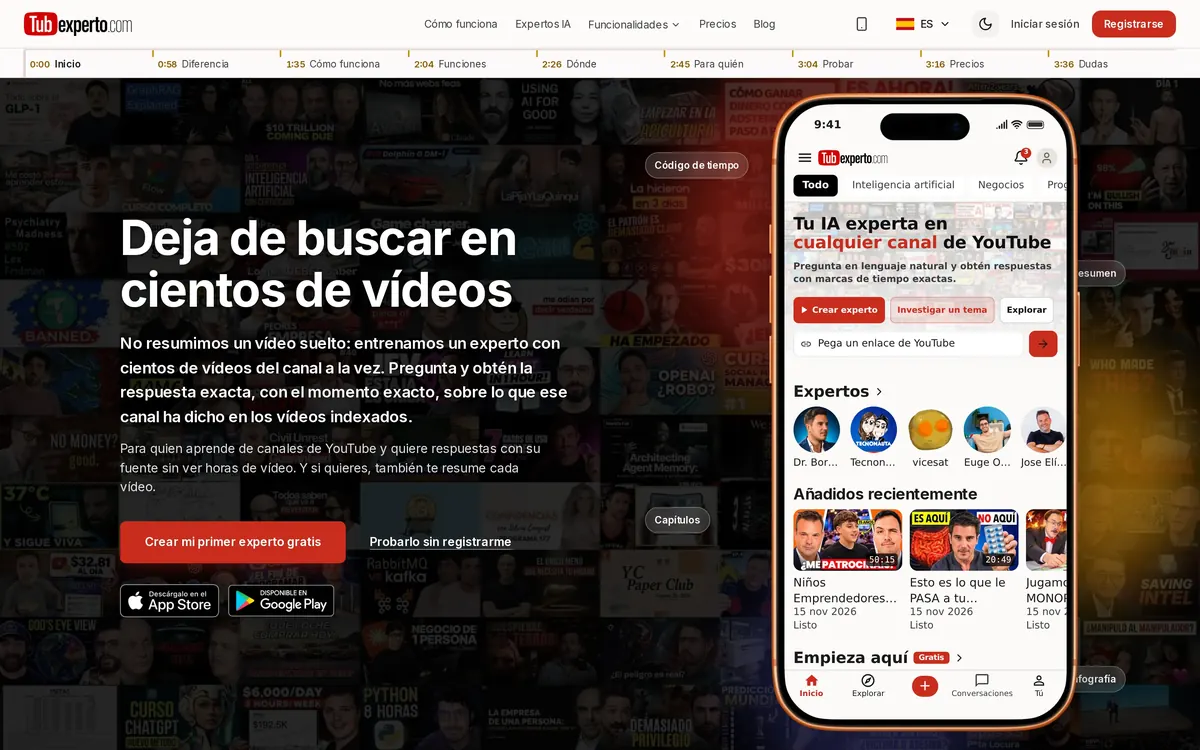
Products that can be trained with your own material make this method easier. In Docu.expert you upload your internal documents and ask questions with the source in view; if the answer does not cite properly, you see it straight away. In TubExperto you index the videos of a channel and check whether the answer points to the exact second. In AudioMap you upload one of your meetings and see whether the minutes capture what was actually agreed. In every case the validation is the same: your material, your questions.
Look at three things. The first is accuracy on what matters: prices, dates, rules, names. An error in an anecdote is tolerable; an error in a price is not. The second is how the system behaves when it does not know. A reliable assistant admits its limit and hands over to a person; an unreliable one makes things up. The third is what happens after the answer: whether the citation can be checked, whether the conversation is recorded, whether the team can review what happened.
That last part is the one that tends to be forgotten. BeautySuite, for example, keeps every call recorded in the dashboard, and VideoSuite tells participants about the recording before it starts. Being able to review things is what lets you trust them after the demo, when nobody is watching any more.

Moving to production should not feel like a leap, but like carrying on with the same thing at higher volume. Plans that include a trial period or a free version make that possible: AgenteUno offers a 14-day trial with no card and no lock-in, AudioMap has a free plan of 300 minutes of audio a month, and TubExperto starts with two experts on its Explorer plan. These are not gifts, they are a way for the product to prove its value with the customer's own data.
When the trial goes well, the investment makes sense on its own: you already know what it does, how accurately, and what it costs. If it goes badly, you have lost a few days and not a contract. That asymmetry is exactly what we aim for when designing the way into each product.
A common question is how much information to share in a trial. The practical rule is to give the minimum that makes the trial representative. For a customer service assistant, the rates, the frequently asked questions and the business rules are enough. For a document expert, a small set of real documents, including an awkward one. For a meeting, one of your own recordings with information that is not especially sensitive.
If the information is confidential, ask first where it is stored and which providers it reaches. Docu.expert offers a local expert that is installed on the customer's computer or server, and AudioMap transcribes with AssemblyAI in its European Union region and stores the audio in Cloudflare R2, although the web chat and notifications use providers in the United States. What matters is knowing where your data lives during the trial and what happens to it if you do not continue.
A trial should be run by the person who will use the tool, not only by the person who buys it. If it is a reception assistant, let whoever answers the phone test it. If it is a minutes generator, whoever writes the minutes today. Those people spot in minutes what a manager would take weeks to see, and their acceptance decides whether the product is used or abandoned. Involving them from the start also reduces resistance to change, which is often the real cause of many failures.
Finally, it helps to write down what you learn in the trial: which questions went well, which failed and what was missing from the data. That record helps you decide with good judgement and, if you go ahead, set up the product better from day one.
Validating does not mean spending without control. Trials with generated voice, image or video have a real cost per use, and it is wise to set a ceiling before you start. LaunchSuite builds that in as standard for product launches, with a spending cap, and AvatarSuite works with credit packs that do not expire, with no subscription. Whatever the tool, decide how much you are willing to spend to test the idea before you test it.
In short: a prototype with your data, a narrow case, a criterion written in advance, a spending ceiling and a way out. With that, the decision to invest stops being an act of faith.
You may also like


What we learn in each product goes into building yours too. Tell us what you need and we will reply with a proposal.
Tell us about your caseBefore buying tools, work out which repeated task costs you most when it is not done. A practical way to start with what you will notice.

When a customer can leave at any time, the product has to earn the renewal every month. Why that is a good discipline and how it translates into plans.

A way of selling based on letting the customer see the product, ask whatever they want and decide at their own pace. What it involves and what its limits are.