

Build for yourself first: why dogfooding teaches you what the customer needs
A lab that uses what it builds every day finds the faults, gaps and real priorities sooner. This is how we see it at Codelabs Studio.

A way of selling based on letting the customer see the product, ask whatever they want and decide at their own pace. What it involves and what its limits are.
Traditional software sales follow a well-known script: contact form, a call to "understand your needs", a guided demonstration, insistent follow-up and a closing call. It works for the seller, but it leaves the buyer with little control: they have to hand over their phone number, coordinate diaries and put up with pressure they did not ask for. Many buyers, especially in small businesses, drop out before the second call.
With our own products we have chosen the opposite: the main action is to see the demo, and the demo is available without asking for a phone number or an hour of someone's time on a call. The buyer looks, tries and asks when they want. If they decide they need to talk to a person, they can ask for one, but it is not a requirement for understanding what the product does.
The central idea is that an agent available at any hour explains the product using the company's real information and answers whatever it is asked. It is not a salesperson in disguise: its job is to resolve questions, not to close. That difference can be enforced by design, not merely promised, by programming the behaviour so that it does not insist or use urgency tactics.
AgenteUno is the piece that makes it possible. It answers by voice, WhatsApp, web chat, SMS, email, Instagram and Messenger, using the company's information, and hands over to a person when needed. Applied to sales, it means that someone who lands on a website at eleven at night can ask about prices, plan limits or integrations, and get a useful answer without waiting until the next day. For the buyer it is convenience; for the company, an enquiry that is not lost.

An open demo is only convincing if it is honest. That takes three things. It must show the product as it works, not an idealised version. It must use believable information from the visitor's sector, so they can judge whether it fits. And its limits must be in plain sight: if the product is in beta or early access, it says so. Lexiel and Fotifai are listed as beta, and DivanSuite is in early access: you try it with sample patients until work with real patients is switched on. Presenting them as established would be lying by omission.
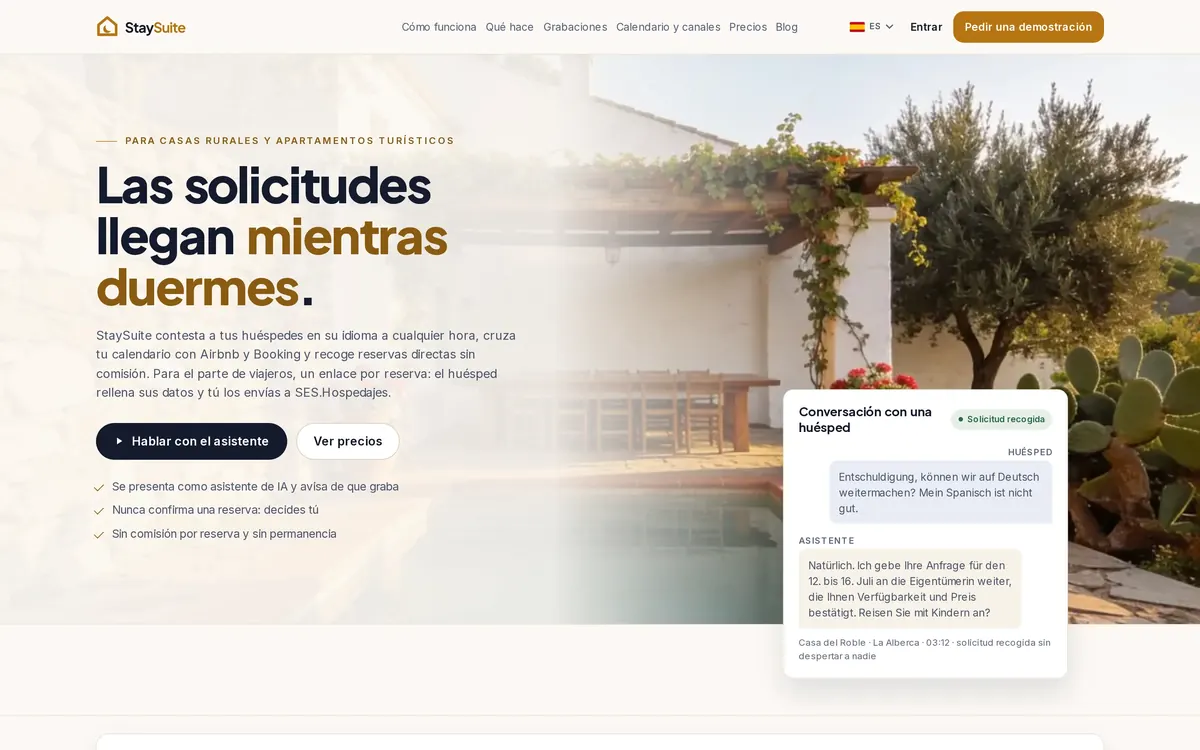
In the sector versions, the demo can even speak the language of the trade. A BeautySuite assistant shows the menu with its prices and durations; the StaySuite one serves guests in their own language; the OdontoSuite one respects a clinic's health rules. The visitor does not have to imagine how it would look in their business: they see it.
Selling without pressure does not mean selling blind. You can measure which sectors arrive, what questions they ask and where they drop out, without chasing anyone. That information is used to improve the page, the demo and the product. Contact, when it happens, only takes place with the person who asked for it.
The useful rule is to separate two questions: "what has this person seen?" (aggregated information, useful for improving) and "who do I call today?" (a sales action, only if there is a request). Mixing them is what turns an analytics tool into a harassment machine.
Not everything sells itself. Products that need onboarding (for example ClinicSuite with its set-up fee, or TrichoSuite with its launch support) require guidance, and some customers simply prefer to talk to a person. Forcing them into an automated demo would be just as uncomfortable as forcing them into a call. The condition is that the human option exists, is available on request and is not a barrier.
It does not work without a clear product either. If the offer is confusing, no agent will fix it. Visible prices, comparable plans and simple terms (no lock-in, with a trial) are half of selling without pressure. We cover that in the next article.
Imagine a manager of rural holiday lets who lands on the StaySuite page. Instead of filling in a form and waiting for a call, she can watch the assistant handle a booking request, check that it warns when the requested nights are taken, look at the calendar synced with Airbnb and Booking through iCal and read what each plan includes. All of that without speaking to anyone.
If after seeing it they want to ask something, the assistant answers on the spot. And if they want to talk to a person, they ask for one. The order is decided by the buyer and not the seller, and that is what changes most compared with classic selling.

Under pressure, the buyer feels they have to defend themselves. Without it, they can ask what worries them: what happens to my data, what happens if I leave, what does the product not do. Those questions are gold for the seller, because they are the real objections. An agent that answers them clearly, and that admits the limits, creates a trust that no closing call achieves. The buyer who has been able to ask everything and decide alone is usually the one who regrets it least.
If you sell services or software, try three changes. Put a demo or a real example on your website that can be seen without giving any details. Publish your prices, even if they are indicative. And replace "we'll call you" with "write to us whenever you like" with a quick reply, whether from a person or from an agent that explains using your information. Watch which questions come in: they are your best guide to what to explain better.
The aim is not to sell more by force, but for whoever buys to do so because they understood what they are buying. Those customers stay longer and ask for fewer refunds, and that is what sustains a small business.
You may also like


What we learn in each product goes into building yours too. Tell us what you need and we will reply with a proposal.
Tell us about your caseA lab that uses what it builds every day finds the faults, gaps and real priorities sooner. This is how we see it at Codelabs Studio.

Maintaining a broad portfolio is only possible if every new tool serves all the others. How reuse works in practice.

A demo with catalogue examples is not very convincing. A demo with your real information shows whether it is worth it. A method to validate before you pay.